
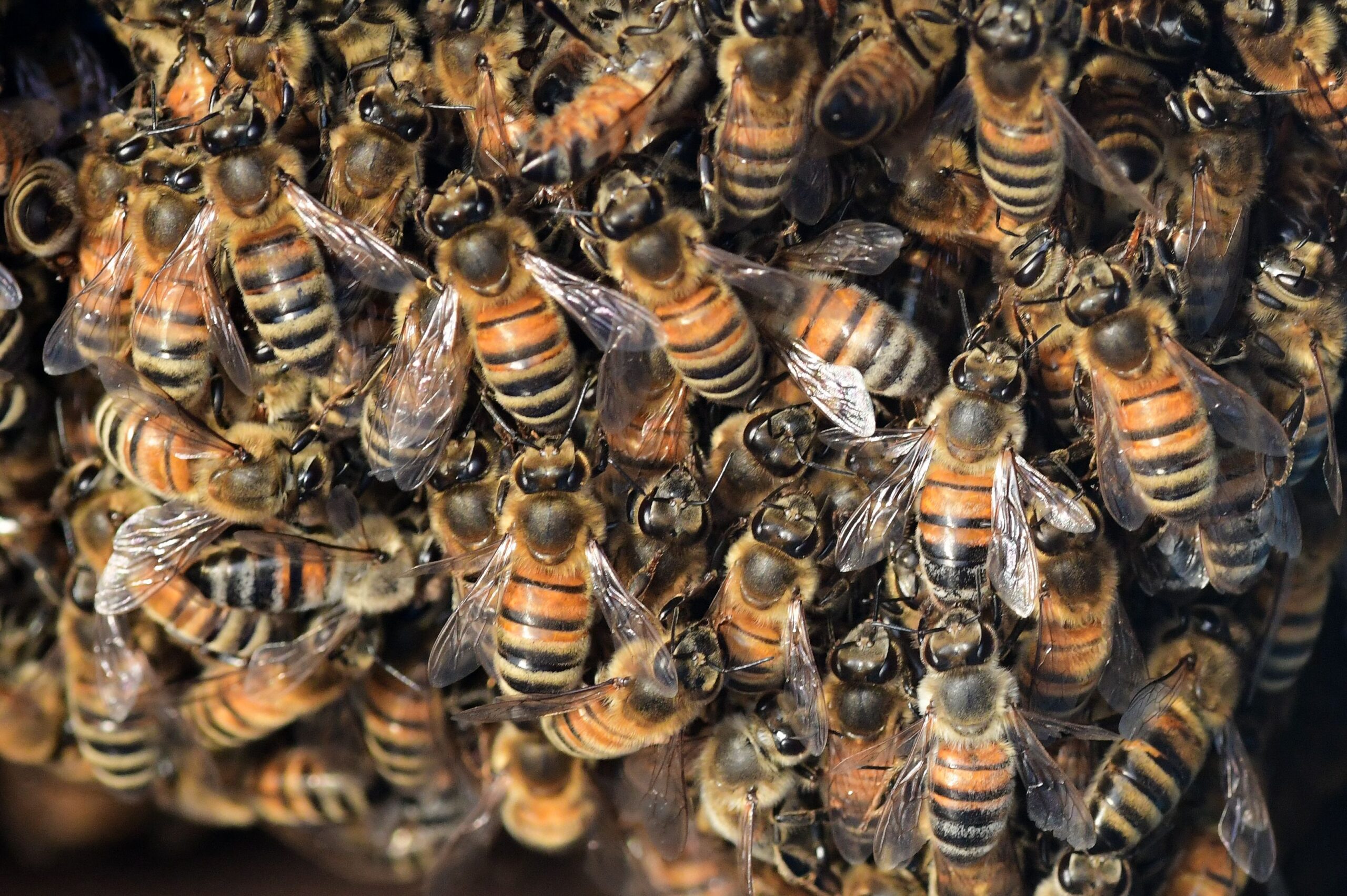
A cloud of bees about the size of a basketball turns up on a tree branch in your yard, and your first instinct is to reach for the bug spray. Hold off. Understandable as that instinct is, it usually makes things worse, for you and for the bees. Up here in Rim Country, bees are a normal part of summer, and most of the time the situation is a lot more manageable than it looks.
At Friendly Pest Control, bees are the one call where our answer is almost never “let’s kill them”. Here’s how to tell what you’re dealing with, and why moving bees out alive beats a can of spray nearly every time.
First, is it a swarm or a hive?

These two look similar and mean very different things, so it’s worth telling them apart.
A swarm is a cluster of bees, often hanging off a branch, a fence, or an eave, that’s on the move and shopping for a new home. Swarming bees have no honey or young to protect, so they tend to be docile, and a swarm will often move along on its own within a day or two.
A hive is another matter. That’s an established colony that has set up shop inside a wall, an attic, a shed, or a hollow tree, complete with honeycomb, honey, and young. A hive won’t leave on its own, and it needs to be handled the right way.
Why spraying is the wrong move
Reaching for insecticide feels like taking charge, but with bees it usually backfires. If it’s a swarm, you didn’t need to do anything, and you’ve killed pollinators we can’t spare. If it’s a hive in your wall, a can of spray won’t reach the whole colony, and now you have dead bees and abandoned honeycomb rotting inside the wall, which draws in ants, rodents, and beetles down the road.
There’s a safety angle, too. Arizona is home to Africanized honey bees, which are far more defensive than their gentler cousins. Poking at a colony, spraying it, or hitting it with a hose can turn a calm situation aggressive in seconds. University of Arizona experts are clear on this point: leave an established colony alone and call a professional.
How live bee removal actually works
When a hive has to go, the goal is to relocate the bees, not wipe them out. Here’s the gist:
- A technician first confirms it’s honey bees and pinpoints the colony, since sound and heat can reveal exactly where it sits inside a wall or roofline.
- The bees are taken out alive whenever possible and handed off to a beekeeper, so the colony keeps doing its job somewhere it’s actually wanted.
- The comb and honey come out as well, because leaving them behind invites a second wave of pests and even new bees.
- Finally, the entry point gets sealed, so the same cavity doesn’t become next season’s hive.
When you can just leave them bee
Not every bee sighting is a problem. A few bees working your flowers are doing exactly what you want them to, and a swarm resting on a branch will usually be gone by the weekend. If the bees aren’t inside your home and aren’t somewhere people or pets have to walk right past, the kindest and easiest move is often to give them a little room and let nature run its course.
The time to step in is when a colony moves into your house, when a swarm settles somewhere you can’t avoid, or when someone nearby has a bee-sting allergy.
When to call in help
There’s an old line that fits bees perfectly: an ounce of prevention is worth a pound of cure. Sealing the gaps and cavities where a colony could move in beats dealing with an established hive later on. But if the bees have already found a way in, you don’t have to sort it out with a spray can and a prayer.
If there’s a swarm you can’t wait out or a hive in your walls, call a Friendly Technician. Reach out today or call 928-363-4232, and we’ll get the bees moved along safely, for your family and for them.